
Aestus captures every change in your systems of record and delivers it in real time, strictly ordered, to any target—databases, lakehouses, graphs, vector stores, APIs, and event brokers—with zero data loss and zero cloud egress.
Every flow chains small, single-purpose container agents through a durable message broker.
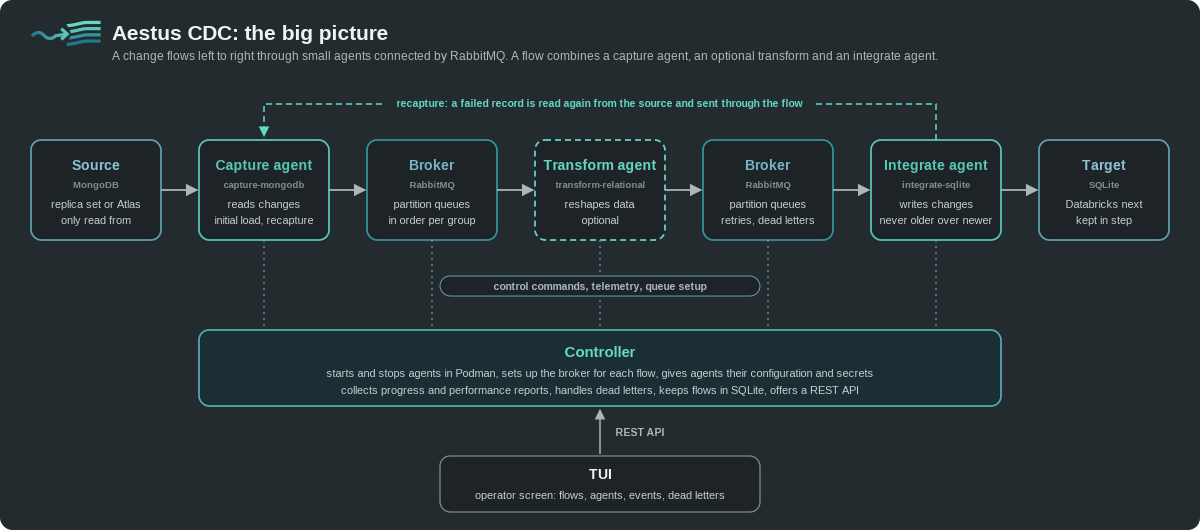
Tails the source's native change log or feed, opening the stream before the initial load starts so no change slips through. Every record is stamped with its key, group, and monotonic version.
Durable broker queues hold every change until the next stage confirms it. Related records share a partition and stay in strict sequence while unrelated groups move in parallel.
Optionally reshape, filter, enrich, or vectorize records in flight—using built-in transforms (transform-relational, transform-rest, transform-vectorize, transform-filter) or custom agents in Go, Python, or C#.
Applies each change idempotently to databases, lakehouses, caches, vector stores, or APIs, rejecting older versions. If a write fails, Aestus recaptures the current record from the source and keeps moving.
The browser-based Visual Flow Designer gives teams an interactive canvas to wire sources, transforms, and targets, validate schemas in real time, and roll out versioned updates with zero downtime.
Visualize capture agents, partitioned broker queues, transforms, and sinks. Reorder stages or add new targets—such as Redis caches, REST APIs, or Delta Lake—with instant validation.
Syncs directly with the Controller REST API (/api/v1/flows) to browse revision history and deploy versioned updates with rolling reconfiguration and safe rollbacks.
Add integrate-redis directly from the canvas to mirror operational changes into Redis with configurable TTLs and key prefixes—keeping application caches fresh without custom invalidation code.
Layout metadata lives in a separate visual-editor: block that the Controller runtime ignores, preserving 100% round-trip compatibility with GitOps, CI/CD, and the CLI.
Replace brittle cron jobs and custom chunking scripts with one self-healing streaming flow—Capture → Map & Enrich → Vectorize → Vector Target → Hybrid Search—powered by local models like Ollama and vLLM or cloud providers.
Tail native database logs (Oracle, PostgreSQL, SQL Server, MySQL), document change streams (MongoDB, DynamoDB, Firestore), lakehouse tables (Databricks, Snowflake), cloud object-store drops, or HTTP webhooks. Streams open before initial snapshots so zero records are missed, with every event stamped with a monotonic _ae_version.
Assemble parent and child rows or flatten nested documents (transform-relational), and call internal microservices or external HTTP/JSON APIs (transform-rest, with TTL caching and health holds) to attach clean text alongside filter fields like tenant_id, ACL roles, price, and availability.
Splits text into context-preserving chunks and computes dense semantic embeddings via self-hosted Ollama or vLLM (zero data egress, zero token bills) or cloud APIs (OpenAI, Azure OpenAI, AWS Bedrock, Vertex AI), alongside lexical Sparse BM25 vectors. Content hashing skips model calls when only metadata changes.
Streams Named Vectors and payloads into Qdrant (integrate-qdrant over gRPC), Elasticsearch, OpenSearch, Pinecone, Weaviate, Milvus, and database vector columns (pgvector, Oracle 23ai, Atlas Vector Search). Deterministic chunk IDs enable idempotent upserts, automatic trailing-chunk pruning, and fast metadata-only patches.
Every vector point combines dense semantic embeddings, sparse BM25 keyword weights, and live operational metadata—enabling single-pass Reciprocal Rank Fusion (RRF) queries that match both natural language and exact SKUs or part numbers, filtered in real time by tenant, ACLs, and stock. Updates, revocations, and deletes appear within seconds.
Consistent reliability, ordering, and operational controls across every source and target.
Copies existing records and transitions seamlessly to live streaming. The change stream opens before the copy begins, and interrupted loads resume where they left off.
Group related collections by a shared key—such as an order and its line items. Changes for the same key apply in strict sequence while unrelated groups scale in parallel.
Checkpoints advance only after the broker confirms durability. Every target record stores its last change version, so late or duplicate messages never overwrite newer data and deletes stay deleted.
Failed writes automatically trigger a recapture from the source, and failed transforms retry with backoff. Persistent errors land in a dead-letter queue to retry, recapture, or discard.
Agents monitor target availability, primary writability, server load, and write latency. When a destination or enrichment API degrades, upstream capture pauses cleanly at its cursor until health recovers.
Use declarative transforms for relational mapping, REST enrichment, filtering, and AI vectorization—with automatic schema evolution—or build custom agents using Go, Python, and C# SDK templates.
Send complete records or only the fields that changed. When a partial update cannot be applied safely on its own, Aestus fetches the full record from the source instead of guessing.
Stream continuously from transaction logs, or run polling and batch sources on a CRON schedule to let cloud warehouses auto-suspend, reduce storage API charges, and avoid peak-hour load.
Author and validate flows in the schema-driven terminal UI (TUI), then monitor live rows/min, 24-hour throughput graphs, end-to-end lag, filtered events, and dead letters from one console or REST API.
Each system has a dedicated capture agent and integrate agent. Mix and match any source with any target across databases, lakehouses, APIs, and event brokers.
| System | As a source | As a target |
|---|---|---|
| Relational Databases | ||
| PostgreSQL | pgvector planned | |
| MySQL and MariaDB | ||
| SQL Server and Azure SQL | vector columns planned | |
| Oracle Database | vector columns planned | |
| SQLite | Planned | |
| Lakehouses & Object Storage | ||
| Databricks & Delta Lake | ||
| Snowflake & Apache Iceberg | Planned | |
| Object Storage (AWS S3, Azure ADLS Gen2, GCS, File System) | ||
| Document Databases | ||
| MongoDB and Atlas | ||
| Cosmos DB and DocumentDB | NoSQL API change feed planned | |
| Amazon DynamoDB | Planned | |
| Google Firestore | Planned | Planned |
| Apache Cassandra | Planned | |
| Redis | Planned | |
| Graph Databases | ||
| Neo4j and AuraDB | Planned | Planned |
| Amazon Neptune | Planned | Planned |
| Graphs in PostgreSQL, MongoDB, SQL Server and Oracle | ||
| Vector & Search Databases | ||
| Qdrant | Planned | |
| Elasticsearch and OpenSearch | Planned | Planned |
| Pinecone, Weaviate, Milvus | Planned | Planned |
| Vector columns in your database | Planned | |
| Databricks Vector Search, Snowflake Cortex Search | ||
| APIs & Event Brokers | ||
| Apache Kafka, Confluent, MSK, Redpanda | Planned | general-purpose producer planned |
| RabbitMQ | Planned | Planned |
| Azure Service Bus | Planned | Planned |
| Azure Event Hubs | Planned | via the Kafka endpoint today |
| AWS SQS, SNS, Kinesis, EventBridge | Planned | Planned |
| Google Pub/Sub | Planned | Planned |
| NATS and MQTT | Planned | Planned |
| REST APIs and webhooks | polling planned | |
| gRPC services | Planned | |
Operational and reporting SQL databases: PostgreSQL, MySQL, SQL Server, Oracle and SQLite.
ExploreCloud lakehouses, open table formats, and object storage: Databricks, Snowflake, Delta Lake, Apache Iceberg, S3, ADLS Gen2, GCS, and local storage.
ExploreDocument, key-value, and wide-column stores: MongoDB, Cosmos DB, DynamoDB, Firestore, Cassandra, and Redis.
ExploreProperty graphs in Neo4j and Neptune, plus graphs modeled inside PostgreSQL, MongoDB, SQL Server, and Oracle.
ExploreTurn any database, lakehouse, or file drop into live AI search and RAG with in-flight vectorization and vector stores.
ExploreApplication APIs and enterprise message brokers: push changes to services and streams, or start flows from them.
ExploreThe broker, controller, and every agent run as lightweight containers inside your own network.
One compact image per agent. Choose your runtime at Controller startup (-runtime podman, docker, or k8s) to supervise rootless containers or Kubernetes Deployments.
Scale transforms and sinks across parallel partitions where every replica serves as a warm standby for its peers. Capture agents support parallel stream splits or broker-leased warm standby.
The Controller is never on the data path. Restarting it never pauses running flows—agents keep streaming and self-healing autonomously, with optional warm-standby Controller HA (-ha-standby).
Passwords and connection strings stay in platform secrets (Podman, Docker, or Kubernetes Secrets) and are injected at runtime—never stored in flow YAML files.
Export flows to standard Terraform / OpenTofu definitions so platform teams can review, version, and promote pipelines across environments using existing GitOps workflows.
Aestus is an enterprise product delivered with consulting from Helium Consulting Services and Providentia World Wide—helping you design flows, deploy securely, and operate at scale.
Relational databases, cloud lakehouses, object storage, document stores, graph databases, search engines, vector stores, REST/webhook/gRPC APIs, and enterprise event brokers. See the full matrix in Sources & Targets.
Group related tables or collections by a shared key—such as an item and its inventory rows by item ID. All changes for a key travel through the same partition queue in order while other keys run in parallel.
The integrate agent does not stall the flow. It requests a fresh recapture of the record from the source; persistent failures move to a dead-letter queue where operators can retry, recapture, or discard them.
Yes. Common transforms (relational mapping, REST enrichment, filtering, and AI vectorization) are configuration-only. For custom logic, Aestus provides SDK templates for capture and integrate agents (Go) and transforms (Go, Python, and C#).
No. The broker, controller, and all agents run inside your own network on Podman, Docker, or Kubernetes. Data moves directly between your sources, your broker, and your targets.
Stopping the Controller never interrupts running flows—agents continue streaming and self-healing through the broker. When a scaled replica stops, peer replicas automatically take over its partitions with no data loss.
Yes. Polling and batch sources (object storage, Delta Lake, Databricks SQL, and watermark tables) support CRON schedules so cloud warehouses can auto-suspend and operational databases avoid peak-hour queries.
Unlike Debezium and Kafka Connect, Aestus requires no JVM tuning or mandatory Kafka cluster and includes built-in cross-model transforms. Unlike SaaS batch ETL, it streams in sub-second latency entirely inside your network.